The client
Public institutions make decisions that simultaneously affect very different interests, sensitivities and visions. Communicating these decisions requires more than clarity: it requires building a space where different perspectives can meet without losing their complexity.
In this context, Barcelona City Council promoted the forum "City, tourism and culture: a joint opportunity", organised by the Department of Tourism and Creative Industries with the collaboration of the Sisena Tinència d'Alcaldia de l'Àrea de l'Àrea de Cultura, Educació, Ciència i Comunitat. The aim was not to present conclusions, but to bring together specialists, institutions and professionals to reflect together on the future of the relationship between tourism and culture after the pandemic.
The context
City, tourism and culture are usually approached as independent spheres. Sometimes they even appear at odds, as if the progress of one necessarily implied the renunciation of another.
However, the reality is much more complex. Every decision related to tourism transforms the city. Every cultural policy influences its attractiveness. And each urban change modifies the way in which citizens and visitors experience the territory.
The challenge was to communicate this complexity without reducing it to a simplistic message.
The voltage detected
When a conversation brings together diverse interests, there is a natural tendency to summarize it in a single story.
But some debates lose their value precisely when they are simplified.
The strategic question was not how to represent three different concepts.
It was how to represent the enduring relationship between them.
Diagnosticor
The discovery was to understand that the protagonist of the project was not any of the three concepts.
It was conversation.
City, tourism and culture do not function as watertight compartments. They are part of the same system where any decision alters the balance of the whole.
Communication had to reflect this interdependence.
It was not a matter of explaining who was right, but of building a visual framework that would allow us to understand that all perspectives were part of the same debate.
The strategic decision
The strategy consisted of abandoning any literal representation of Barcelona or tourism.
We did not seek to illustrate a city or represent an economic sector.
We sought to visualize a complex conversation.
Only when that strategy was defined did it make sense to build a visual system capable of expressing it.
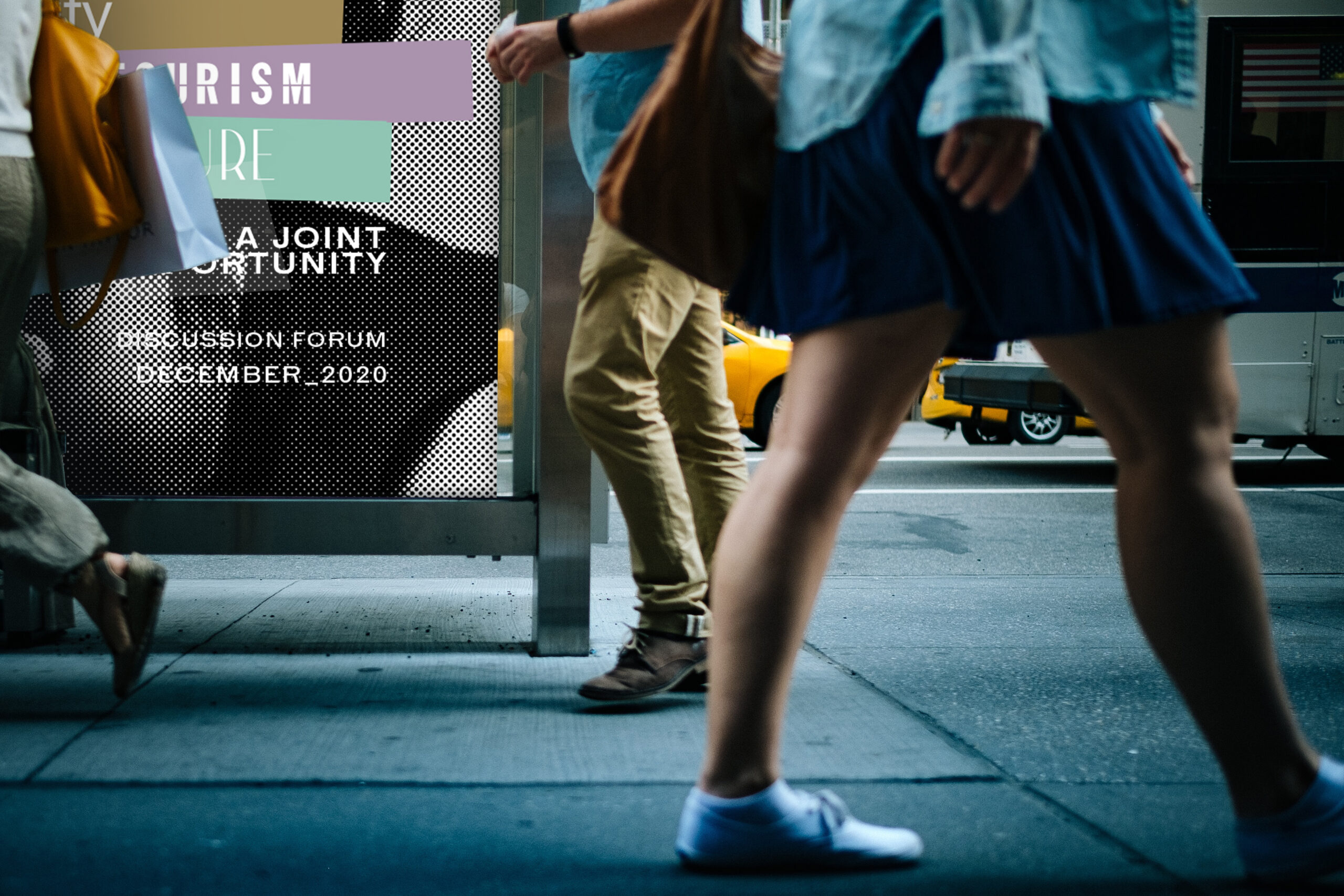
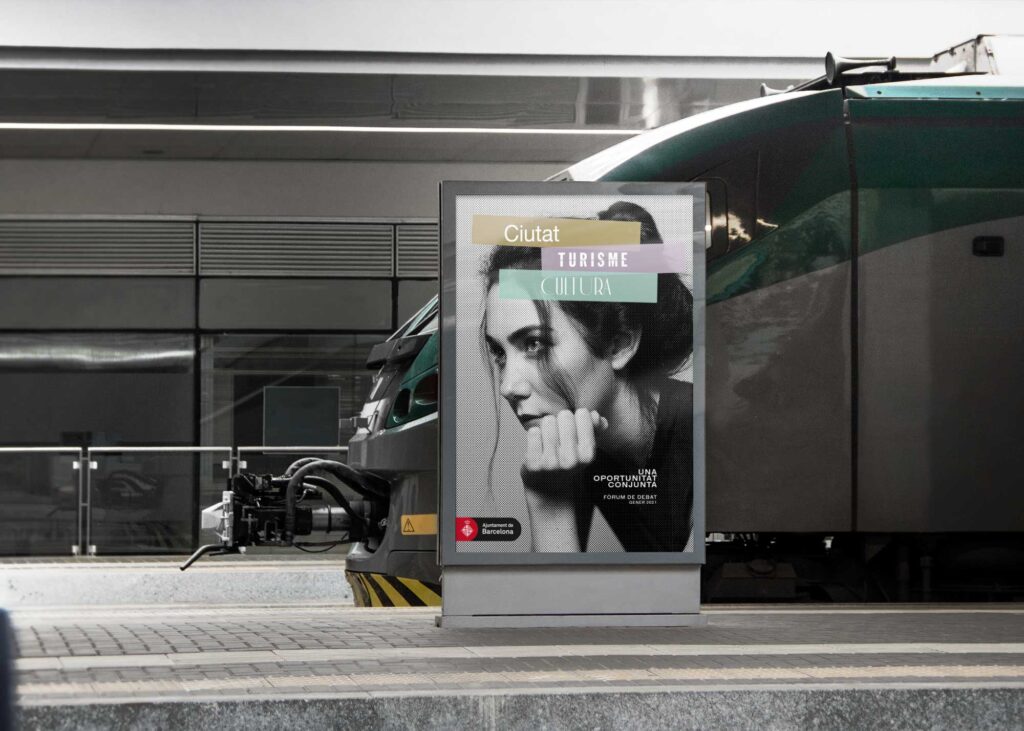
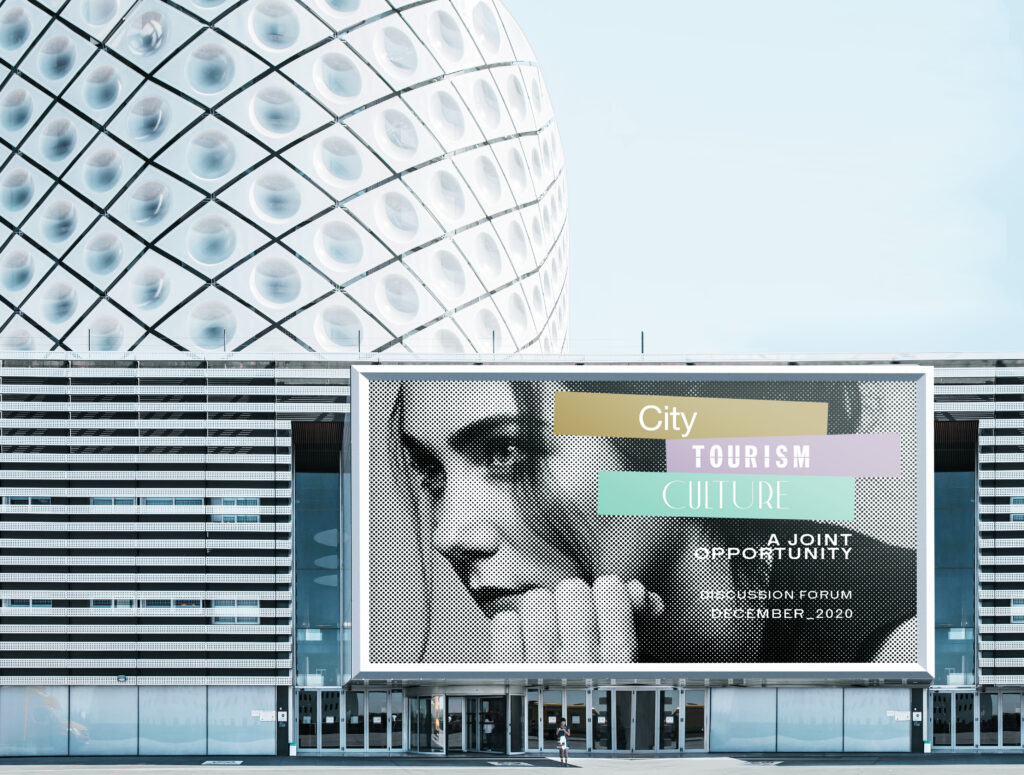
The three graphic bands did not represent three independent blocks, but three dimensions that shared the same space and whose reading only made sense when they were understood together.
Identity ceased to explain an event to become the visual structure of a dialogue.
Perception
The communication ceased to present the forum as a succession of presentations to convey a much broader idea: the need to build a shared view of a city challenge.
Identity did not guide the audience towards a conclusion.
It invited them to participate in a reflection.
Design ceased to act as a decorative element to become a tool for understanding.
Materialization of the strategy
The strategy was transferred to a graphic system based on the coexistence of three visual planes that occupied the same space without losing their identity.
Photography avoided the usual codes associated with urban tourism and shifted the protagonism towards reflection. More than representing Barcelona, it represented the necessary attitude to face a complex debate: observe, listen and think.
Each visual element responded to the same strategic decision: to build an identity capable of ordering a conversation, not simplifying it.
Case learning
Complex problems rarely admit simple answers.
When communication tries to reduce them to a single message, it usually loses what makes them relevant.
The strategy often consists of doing exactly the opposite: offering a structure that allows complexity to be understood without eliminating it.
Because communicating does not always mean explaining an idea better.
Sometimes, it means creating the conditions so that different ideas can meet, debate and evolve.
That is, for us, one of the greatest values that strategic branding can provide.
External links:
Article by Barcelona Metròpolis on the Fòrum Ciutat, Turisme i Cultura Barcelona.
Related Services
- Research and strategic diagnosis
- Narrative and visual identity
- Creative direction
- Exhibition design
- Art direction
- Editorial design