
The same car. Manufactured by a different world.
How we turned one of Volvo's greatest industrial challenges into a story about technology, knowledge and people capable of sharing the same idea of quality.
Customer and sector
ABB Robotics is one of the world's leading companies in industrial automation and robotics applied to automotive manufacturing.
In 2013, it participated in the start-up of the new Volvo Cars plant in Chengdu, the group's first factory in China.
ABB had to implement the necessary robotic solutions so that the plant could produce vehicles with the same quality standards as Volvo's European factories.
The company supplied 33 robots and developed, over six months, the first fully automated station in the Chinese market to apply water-based soundproofing adhesive.
But its involvement went far beyond installing technology.
To make the robots work, ABB had to be an implicit part of the construction of the factory, the definition of its processes and the coordination between teams, suppliers and specialists from China and different European countries.
Context and problem
Volvo had set out to manufacture a car in China without any qualitative difference from the vehicles produced in Europe.
The place of manufacture could change.
The quality could not.
On paper, the objective seemed to be to reproduce an industrial line: install equipment, move processes and start up a new factory.
But an automobile plant is not a succession of machines.
It is a system in which thousands of decisions, components, movements and people must work in a coordinated manner.
The real challenge was not to bring European robots to China.
It was to get a new industrial organization, built by people of different backgrounds, languages and cultures, to manufacture an unmistakably Volvo car.
Detected voltageHow
do you make the same car when almost everything involved in its manufacture is different?
Different country.
Different equipment.
Different suppliers.
Different languages.
Different industrial cultures.
And yet a single standard.
The car that came out of Chengdu could not be a rough interpretation of the one made in Europe.
It had to meet the same technical demand, convey the same sense of quality, and represent the same brand promise.
The car had to be identical.
Getting all the processes that made it possible were also a different story.
DLAB Diagnostics
Quality is not copied.
It is transferred, interpreted and shared.
Technology made it possible to automate production.
But technology alone could not guarantee the result.
To replicate an industry standard, it was necessary to transfer knowledge, coordinate suppliers, agree on processes and ensure that professionals from very different cultures understood in the same way what it meant to manufacture a Volvo.
ABB provided the robots and automation expertise.
Volvo brought decades of knowledge in engineering, manufacturing and safety.
The Chinese teams provided an ability to execute, adapt and learn that impressed everyone involved in the project.
The factory did not start operating when the machines were installed.
It began to work when all those people managed to work as a single system. Strategic
decision
The initial assignment was to create a case study on ABB Robotics' involvement in Volvo's new factory in Chengdu.
We could have explained the number of robots installed, the characteristics of the line, or the complexity of the technical solutions developed.
All of that was important.
But it wasn't enough to understand what the project had made possible.
DLAB's narrative decision was to shift the center of the story.
From machines to people
Because behind each robot were engineering teams, process managers, specialists, suppliers and professionals from China and many European countries.
People who had to understand each other, share knowledge and solve problems together that could not be anticipated from an office thousands of miles away.
The project started as a story about automation.
The research revealed that it was a story about collaboration.
Verbal, visual and perceptual result
The case study presented the factory as the result of a challenge shared between countries, companies and cultures.
Technology continued to occupy a fundamental place, but it was no longer appearing as an autonomous solution.
Robots were not a substitute for people's knowledge.
They made it reproducible.
The narrative showed that industrial precision is not born only from machines, but from the ability of an organization to ensure that thousands of decisions maintain the same criteria.
ABB did not appear simply as a supplier of equipment.
It appeared as part of the human and technological system that made it possible to build the factory, transfer knowledge and achieve the standards demanded by Volvo.
The result could be summarized as follows:
Three countries.
Two companies.
Multicultural teams.
The same standard.
Materialization of the strategy
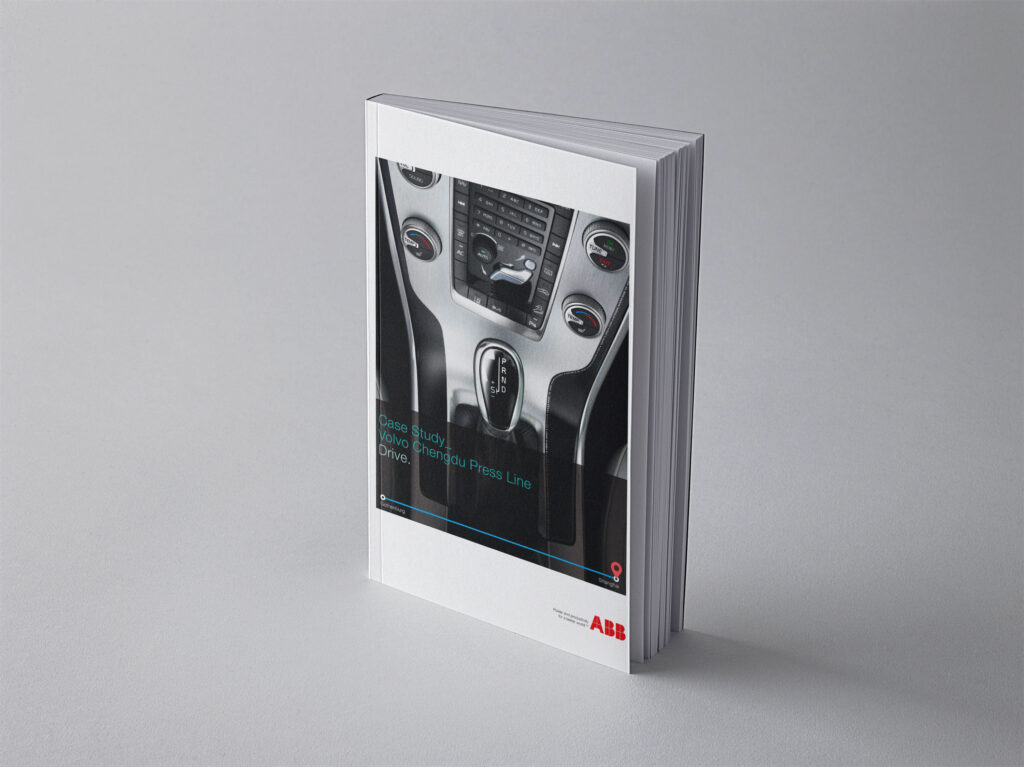
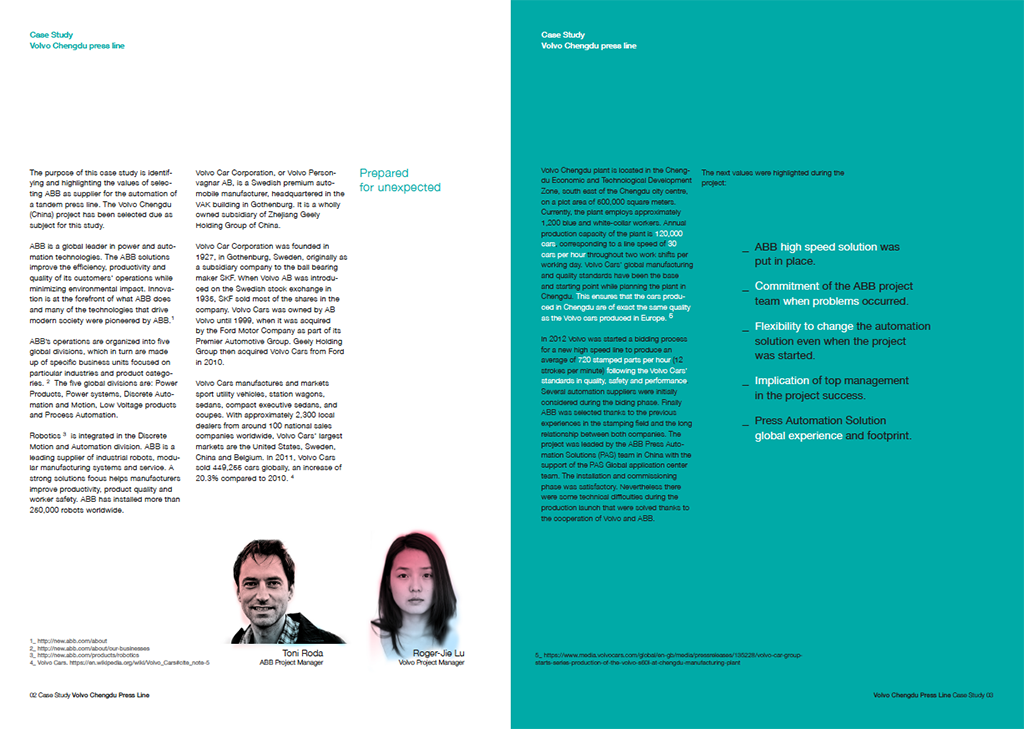
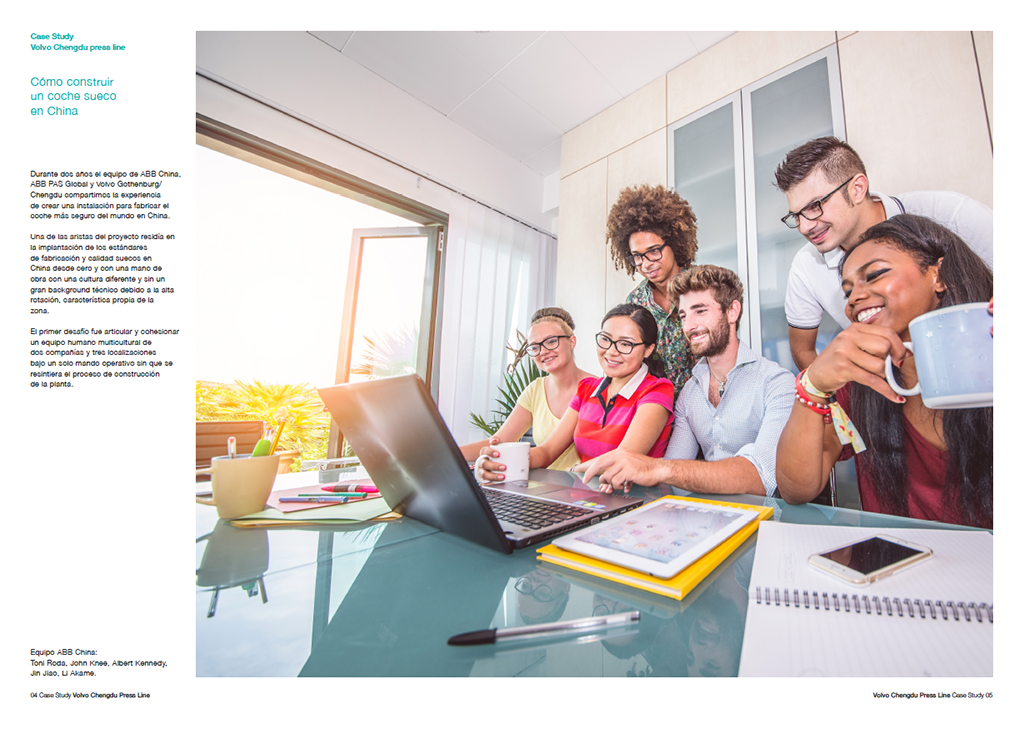
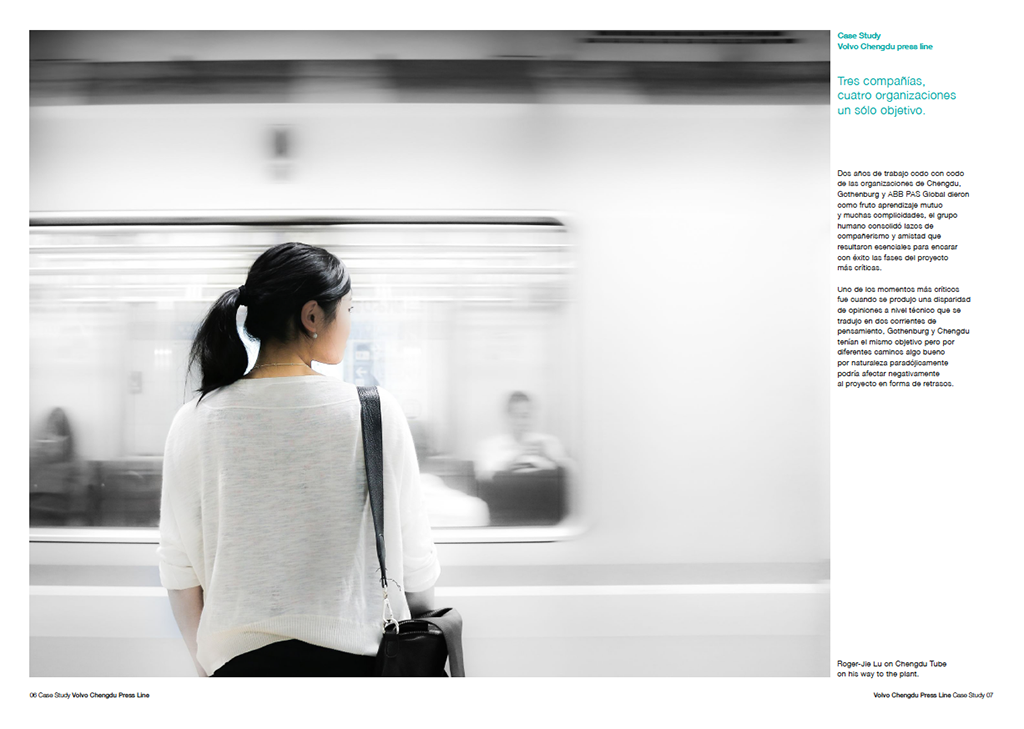
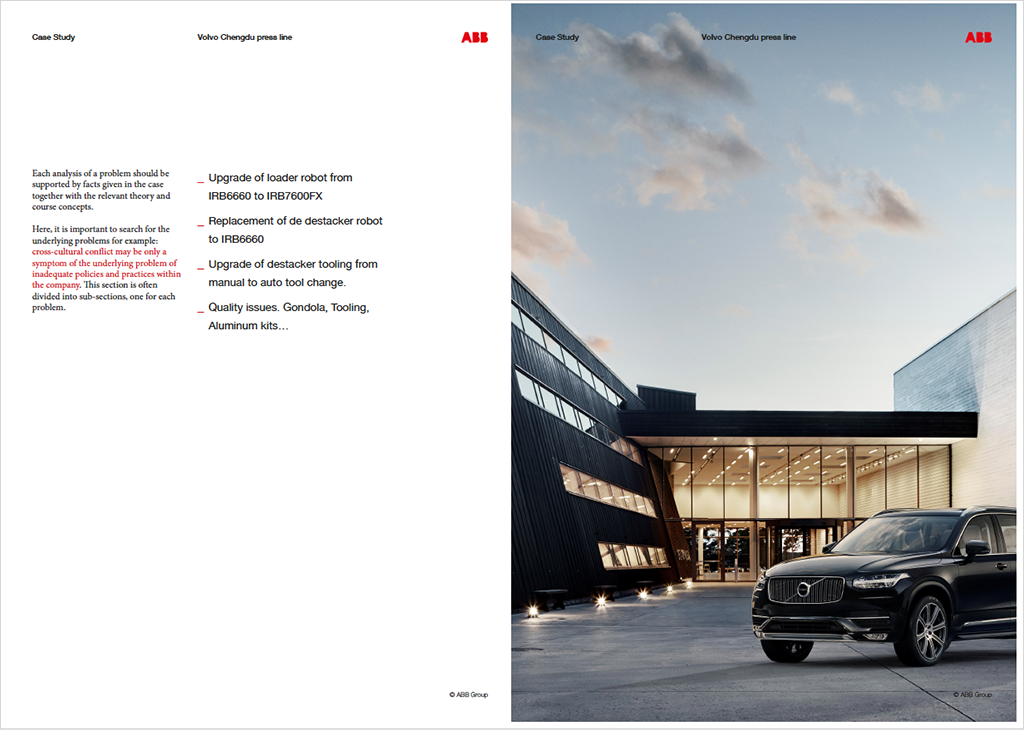
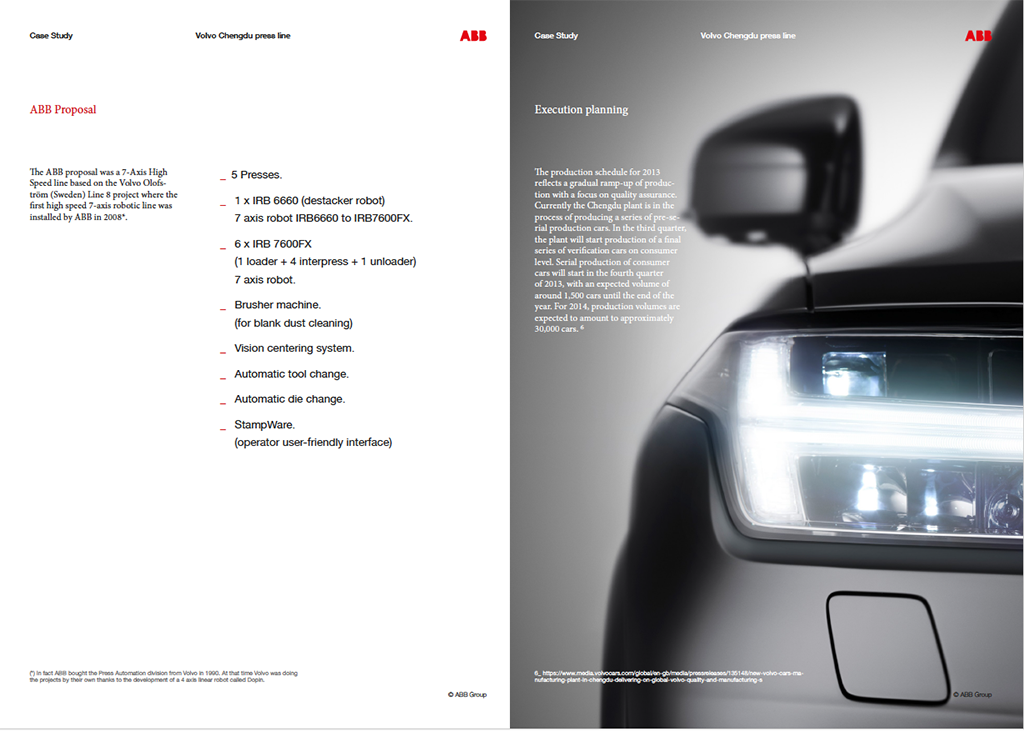
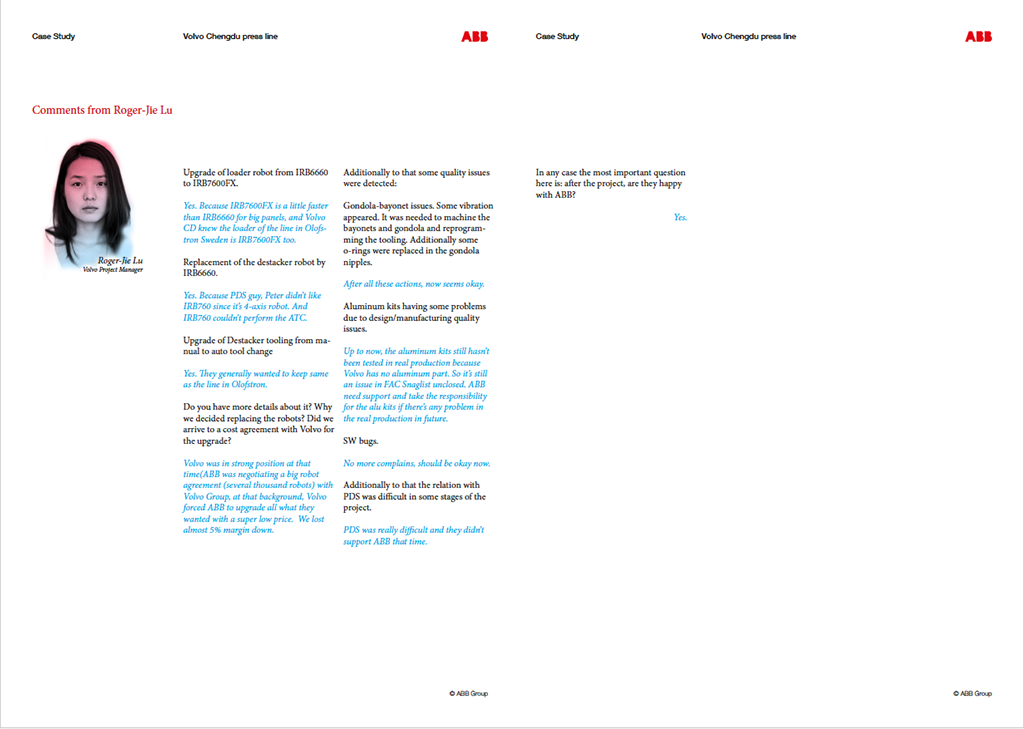
The project materialized in a physical and digital publication designed for internal and external dissemination.
The structure combined business context, technical information, process documentation, images of the plant and the testimony of the people involved.
The format had to make an industrial project of enormous complexity understandable without reducing it to a list of figures, machines and specifications.
The publication made it possible to explain what had happened, how it had become possible and what ABB could learn from that experience for other international projects.
Each section contributed to building the same idea:
Factories are built with technology.
Standards are built between people.
The retrospective look
In 2013, the new factory in Chengdu could be interpreted as the decision to produce locally in order to grow in the Chinese market.
Geely had acquired Volvo Cars in 2010. Three years later, Chengdu began series production of the Volvo S60L.
At that time, the challenge was to prove that China could manufacture a European car with the same quality standards.
But the meaning of that project changes when we look at it from the present.
In the years that followed, Geely acquired a controlling stake in Lotus, its founder became the largest individual shareholder of Daimler – now the Mercedes-Benz Group – and the group became a shareholder of Aston Martin.
China was no longer understood only as a place of production or a destination market.
It became one of the hubs from which the global automotive industry was being redefined.
Those who participated in Chengdu had already perceived one of the reasons.
Speed.
Efficiency.
The ability to learn, adapt and improve.
Looking at it today, we were also witnessing a new industrial powerhouse embedding that knowledge, making it its own, and preparing to compete with it.
Learning from the case
The first validation car produced with ABB's solutions rolled off the line in December 2012. A year later, the Volvo S60L officially began marketing in China.
The vehicle was the visible result.
Behind it was everything that had needed to be aligned to make it possible: companies, countries, suppliers, processes, technology, and people.
DLAB decided to tell that part of the story because therein lay the true value of the project.
A car can reproduce.
A way of doing things must be learned and shared.
Today, that case study allows us to understand something that in 2013 was only beginning to become visible.
The Chengdu factory was not just a new Volvo plant.
It was one of the places where Europe and China began to manufacture a new global industry together.
Related services
Research and strategic diagnosis · Narrative conceptualization · Corporate storytelling · Interviews and content creation · Creative direction · Editorial design · Corporate communication · Physical and digital case studies
Links:
Driving the digital future of chinese insdustries with ABB Tech
Case study: An administration that has been easy to do?